Monday, January 14, 2019

Film


Industry and Audience


Film = Industry only 
Radio = Industry and Audience 
Video Games = Industry and Audience 

Film Industry - Creating a Film:
- Ideas 
- Study decides who produces 
- Storyboard and scripts 
- Film the shots (production) 
- Editing 
- Trailer, billboards, social media, posters, brochures, adverts 
- Premier, focus groups, testing the film 
- Distribution - shown in cinema 
- DVD, Netflix 


4 Stages of Filming:

1. Production - development, pre-production, production, post-production 
2. Distribution - how film is distributed 
3. Marketing - posters, apps, television, interviews 
4. Exhibition/Exchange - the way people consume films, e.g. showing films in cinemas or renting/buying DVDs or downloading films

Primary aim of production company:
To make a profit = good business 

They will make money = Having a distribution plan, marketing and promoting a film 

Conglomerates - is when two or more companies engage in a multi-industry company 

Ownership types:
Horizontal integration:

Vertical integration: When the production company has ownership of the means of production, distribution, exhibition of the film by the same company as they receive all of the profit. 


Thursday, December 13, 2018

Evaluation - Newspaper


Evaluation


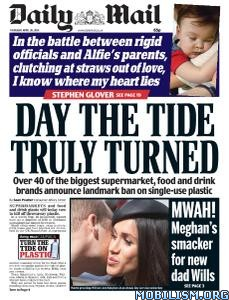
This is the newspaper article that I used as my main influence to create my own Daily Mail front cover. We were assigned a task to replicate a Daily Mail cover, including selected stories, advertisement and a gender stereotype/targeted skyline at the top. The paper above demonstrates the layout of text and images that I was able to look at whilst making my own; whilst ensuring the font matched up and the text was the same size, and the language used would be difficult to identify which cover was the real one and which was mine. 


What programmes did you use to complete the task?
Firstly, I used Photoshop to edit the Christmas holly onto a dark blue text box, similarly to the one on the official Daily Mail newspaper. This meant changing the shape, size and position of the image against the advert section - including text in a while bold font to stand out. Despite the advertisement being small, the colour of it is significant so that it still grabs the attention of the reader. On the other hand, I used Publisher to put together the article in the same way the other one is presented. Publisher allowed me to set the page as an A3 size and compose the piece, editing along the way.

What tools did you use to create the task?
On Photoshop the following tools and skills were used:
- Cropping of images and text boxes to fit the content
- Brightening of images to make more engaging
- Move tool
- Inserting text to make the advert
- Sampling colour onto the text box

Other than Photoshop I used:
- Safari to search for appropriate images, such as Christmas lounge-wear, Ant and Dec from I'm A Celebrity, Daily Mail logo, holly berries and a print screen of the Daily Mail title (created online)
- Safari to identify the fonts used on a Daily Mail front cover  
- A colour gradient text box, fading from black to burgundy, used for the skyline

What are the biggest obstacles to completing your task?
When creating my newspaper I faced some obstacles that had I had to overcome in order to make the front cover convincing and accurate, like the official one. The following things demonstrated difficulty:
- Finding the correct font for the Headline and Master head
- The sizing of text contrasting the images
- Using appropriate images to use on a newspaper front cover
- Writing the correct terminology in the form Daily Mail would
- Keeping the colour scheme the same as the official copy

Describe your production and why you chose the various text headings and images?
To show an accurate representation of a newspaper, I needed to use a dramatic heading to entice the reader. I wrote "ENERGY DRINKS ARE DECREASING YOUR CHILD'S IQ". Using a bold statement such as this would interest any parent who has children (especially young children and teenagers). I used the Christmas pyjamas because they are stylish and would be worn be a varied audience, therefore the image will appeal to the readers. 

What was your initial feedback? What did others say about your production?
Initially the feedback that I received was to change the headline font and to ensure there was limited space in between content and images on the cover. It had to represent features of a real Daily Mail newspaper, and the first response was to work on a few things in order to do that. Improvements to the paper were to change the images in the skyline because it wasn't relevant to the promotion. The newspaper was in the time period leading up to Christmas and I had inserted a bikini image in the summer. People wouldn't be thinking about summer and dieting at Christmas time. So I changed the title to fit the time period. 

Identify what went well and with hindsight what would you do differently?
What went well was the accuracy of the newspaper - meaning the font of the headline, the short line spacing between the text, the skyline colour and title and advertisement. Changes I would make to the front cover would be the colour of the advertisement box from a dark purple to a lighter one, similarly to the front cover I used as influence. I would have made the masterhead less fuzzy by finding a way not to stretch the text. 


Monday, November 26, 2018

Millennials VS. Boomers


Millennials Vs. Boomers

News Readers 

Millennials - The younger generation (under 30), that get their news from twitter and social media platforms online.

Boomers - The older generation (above 30), that traditionally watch BBC News at 6pm where the main focus is formal news on politics, weather and world issues. Or Channel 4 for catch-up TV.

News Addicts - type of readers/people


  1. Fix - Access news constantly, prompted by a general need and state of distraction
  2. Track - Access news regularly throughout the day to keep up to date with breaking stories
  3. Fill - Access news to pass the time when moving from one place to another 
  4. Indulge - Make time to enjoy the news as a break from everything else in the day 
  5. Invest - Read the news regularly to get an in-depth perspective on stories 

Examples of when stories are posted online before they are published as proper news on tv

- Ariana Grande Manchester terrorist attack
- Bitcoin
- Harry Potter filming scenes being leaked before the film was in screening
- Terrorism attacks
- Natural disasters

The Pros and Cons of social media news

Pros:
- immediacy 
- everyone can report on it 
- stories spread very quickly 
- phones can be where Tv filming isn't 

Cons:
- 140 characters to write a story/post on twitter 
- false news
- facts missing/inaccuracy 
- biased/one sided 
- amateur reporters putting others in danger in order to get news

Top 4 Newspapers 


  1. Metro
  2. The Guardian 
  3. The Sunday Times 
  4. Daily Mail 

Newspapers

The Guardian: Is the 4th famous in the world but 2nd most read. It is known for being a well-written, interesting, informative, intelligent and good for politics.

Daily Mail: Is the most famous newspaper today, however contrasts to the amount of readers making it the 4th most read newspaper. The Daily Mail is known for standing up for ordinary people, interesting, informative.

The Sun: The Sun has a reputation for being entertaining, amusing, good for sport and read by ordinary people. However, the false and exaggerated news makes this newspaper 13th most popular.


Newspaper Terminology


Media Newspaper Analysis


Friday, November 23, 2018

Target Audience


Target Audience


Who does the Daily Mail newspaper target as an audience?
The Daily Mail was first published in 1896 and is a right wing newspaper, for those who are 'pro' Brexit and conservatives. The articles are owned by Daily Mail and General Trust. Similarly, those who are middle aged, middle England, traditionally English, interested in celebrity gossip, makeup/fashion etc. majority of readers lean towards women belong the main target audience due to the content. However, it is nearly split by gender.


Who is the target audience for the Guardian?
The Guardian newspaper targets a well-educated, relatively young, predominantly male and liberal audience centered around London. 52% of Guardian readers are male, and the average reader age is 44. Topics in which they discuss are sophisticated and have lots of body text which enable a reader to interpret and shape their views in the way they want to. The subjects include politics, exhibitions and international news - or human rights, charities, culture or women's issues.


Comparing Newspapers


Comparing the different types of Newspapers 

A Middle Market Newspapers is one that attempts to cater to readers who want some entertainment from their newspaper as well as the coverage of important news events. For instance, Brexit updates or massive politic events that are happening daily


The Daily Mail is a clear example of a middle-market newspaper that uses a story based on Megan Markle, within the Royal family - which is proper news that people would want to know, as the Royal family is well-liked. Contrasting to a human interest story displayed on the top of the newspaper, to engage people and their feelings to the articles written.


The Daily Star shows celebrity drama and informal stories displayed with limited information and large titles covering the majority of the front cover. This is one example of a tabloid written to exploit Cheryl Cole, telling everyone how she is feeling and the ins and outs of her life at this current moment in time. The reason behind why specific audiences appeal to this type of newspaper is because the gossip is entertaining and is softer news than broadsheets, such as The Guardian. groups of people that tend to read these newspapers are mostly preferred by people from the middle social class, less educated, and the younger generation. As a result, the style and content of the newspaper shapes people's opinions into thinking a very one-sided portrayed point of view.


The Times is a broadsheet newspaper, using lots of factual body text to describe in detail what the story is about. Consequently, the main idea is to give the reader the chance to make their own judgements and arguments on the topic themselves. There are limited images and topics discussed that include Brexit, politics, sports, human rights, culture etc. - with very little images illustrated. Those who read broadsheets are stereotypically well-educated, relatively young, male and liberal audience centred around London.


Thursday, November 22, 2018

Cultivated Representation - George Gerbner


Cultivated Representation

George Gerbner - Cultivation theory (or the drip drip effect)

Representations:
- Teenagers = moody, spotty
- Muslims = terrorists, religious
- Gypsies = trampy, fights
- Americans = annoying, fat, loud
- Girls from Essex = fake, orange

❕ The repetition of images, stories etc. begin to shape our beliefs


Who is represented and how is it constructed?
- the person displayed on the front cover is represented as connotations such as a chav or a teenager. This is due to the fact they are wearing a tracksuit, they have covered their face and they are stood in front of a fire that has been created. However, in actual fact these images were Photoshoped together in order to influence and shape people's opinions on the event - through the media.


Wednesday, November 21, 2018

Newspaper Industries


Newspaper Industries

1. In the Executive Summary on page 2, paragraph 4 the overview identifies that: 'today's aggregate advertising expenditure and net circulation figures equate to about half of their 2007 value.' Bullet point why you think this is the case.

I think the reason behind this being the case is that the technology has been advanced and the demand for news has increased digitally. As a result, this is killing the number of hard copies of news articles. Most customers would state that they would rather read articles online as opposed to paper copies of the news - it easier to read and hold a digital device than a newspaper bought on the streets. 

2. On page 7, the market structure is analysed using data provided by the ABC. Who are the ABC and why is their data collection so important for newspaper owners ans advertisers?

The ABC stands for The Audit Bureau of Circulations, which is a non-profit circulation-auditing organisation. It is also a voluntary organisation in India, initiated in 1948 in India. 

3. On page 10, paragraph 2.14 the overview identifies the circulation figures of Sunday newspapers. Thinking about your set products and audience consumption, why do you think Sunday newspapers have traditionally sold more copies that their daily counterparts?

Sunday newspapers have traditionally sold more copies as it is suggested that Sunday is a day of relaxation at the end of a week - the day of rest - the day most people don't work. More people are likely to pay for a copy on a Sunday because at the end of the week journalists and publishers would write soft news contrasting to hard news during the week. Lots of people don't like to read hard hitting news because it isn't nice to read negative stories all the time. 

4. What are the leading broadsheet, tabloid and mid-market tabloids in term of circulation? What are their daily circulation figures?

The Daily Telegraph is a leading broadsheet, whereas The Sun is the leading tabloid. the Daily Mail is a mid-market newspaper. 

5. Think about the Guardian and the Daily Mail - describe their position in the marketplace. 

The Daily Mail is shown to be the second most popular newspaper however, most popular mid market.  Due to the niche audience, The Guardian is shown to be towards the lower ends of the scale. Whereas, The Daily Mail is a Mid- Market and therefore, has broadsheet and tabloid aspects and has a more broad audience. 

6. The Guardian is 'owned by the Scott Trust, a private company whose core purpose is to 'ensure the financial and editorial independence of the Guardian.' How can this be linked with the news values of the newspaper? 

The Guardian media group is owned by the Scott Trust, a private company whose core purpose I to ensure the financial and editorial independence of the Guardian, the papers values are to be honest, fair and bring integrity to the reader. 

7. In terms of digital distribution, what do you think has been more important to the brand identity of national newspapers, the online website or app mobile platforms? Why/How?

In terms of digital distribution I think the mosts significant brand identity has to be about online websites, as many commuters and other people have technological devices such as laptops and tablets that may not be able to download the application therefore it is easier to access the internet. For example people on work breaks are predominantly at computers or desk tops- easiest to view; as most works now ban the use of mobile phones with a certain block/ building due to distraction

8. A lack of 'trust' in newspapers is identified. Why do you think this is?

The UK newspapers appear to be the least trusted in Europe, according to research by the European Broadcasting Union. It carried out surveys of 1000 members of the public in each of 33 European countries for its Trust in media report. The UK by far the least trusted 'written press' of any European country. 

9. Who is the offline and online regulator of the newspaper industry an how effective do you think they are in 'policing' the industry? 

The independent press standards organsisations are the regulators for the most of the UK's newspapers and magazines. They hold newspapers and magazines to account for their actions, protect individual rights, uphold high standards of journalism and maintain freedom of expression for the press. They make sure that member newspapers and magazines follow the editors code. 

10. Look at the following timeline. What's happened to advertising revenues, why are they important? What other ways have the newspapers industries found to survive? examples. 

Print display advertising revenue for the national UK newspapers has grown for the first time in more than seven years, according to a new report on Ad expenditure. Display Ad's in national titles saw revenue growth of 1% year on year in the first quarter of 2018 , putting it at total of £152.6 million for the period. Within tabloids print display advertising grew by 3% year on year. 

Thursday, November 15, 2018

Advantages/Disadvantages of online media


Advantages and Disadvantages


Advantages of online newspapers:

- easier to update (live updates)
- larger audience
- more modern
- easy access for some
- don't have to go out to a shop (more practical)
- free (paywalls - Daily Telegraph, Financial Times,The Times)
- your own personal account to choose topics - personalising it
- contact papers quickly
- comments on news stories - audience participation
- easy to share articles
- more interactive - video


Disadvantages of online newspapers:


- holding something - more liked by people

- internet needed
- can't keep the story
- less accessible for the older generations
- more information in the paper
- pop-ups
- long term eye strain
- technical errors


Advantages of online newspapers:

- easier to update (live updates)
- larger audience
- more modern
- easy access for some
- don't have to go out to a shop (more practical)
- free (paywalls - Daily Telegraph, Financial Times,The Times)
- your own personal account to choose topics - personalising it
- contact papers quickly
- comments on news stories - audience participation
- easy to share articles
- more interactive - video


Disadvantages of online newspapers:


- holding something - more liked by people

- internet needed
- can't keep the story
- less accessible for the older generations
- more information in the paper
- pop-ups
- long term eye strain
- technical errors

Thursday, November 8, 2018

News Table Comparison

News Table

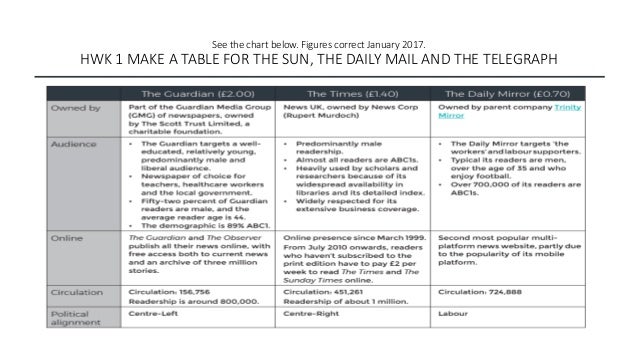
The Sun
Owned by: The sun is a newspaper published by the News Group Newspapers division of News UK - owned by Rupert Murdoch. It became a tabloid in 1969 after it was purchased by its current owners

Audience: The publication is a tabloid, which means that the stories covered and the style used to present them are preferred mostly by people who come from a middle social class, and people aged between 15 and 44. 

Online: The Sun can easily be accessed online, available for viewing and can be seen by anyone who reads it. Articles produced are the same copies in the newspaper.

Circulation: 1451.58 in the UK as of June 2018 (in 1000 copies)

Political alignment: Conservative Political party

The Daily Mail
Owned by: The Daily Mail was founded in 1922 and is a public limited company, run by Paul Zwillenburg (the CEO)

Audience:The Daily Mail is a British daily middle-market tabloid newspaper published in London. Founded in 1896, it is the United Kingdom's second-biggest-selling daily newspaper after The Sun. According to a previous survey, the Daily Mail's audience were considered to be those of the conservative politic views. 

Online: The Daily Mail can easily be accessed online, available for viewing and can be seen by anyone who reads it. Articles produced are the same copies in the newspaper.

Circulation: 1,056.92 as of June 2018 (in 1000 copies)

Political alignment: Conservative Political party

The Telegraph
Owned by:The Daily Telegraph, was founded in 1879. From 1936 to 1972, it was owned by Sir Frank Packer. That year it was sold to News Limited and is now owned by David and Frederick Barclay.

Audience: At The Telegraph we believe that premium content attracts a premium audience. Across print, digital and third party platforms The Telegraph now reaches 52% of the UK population. That’s 23.1 million people a month, 54% of whom are 15-44.

Online: The Telegraph can easily be accessed online, available for viewing and can be seen by anyone who reads it. Articles produced are the same copies in the newspaper.

Circulation: 370.61 as of June 2018 (in 1000 copies)

Political alignment: The personal links between the paper's editors and the leadership of the Conservative Party, along with the paper's generally right-wing stance and influence over Conservative activists

News BBC Bitesize


News and Test


The main conventions in printed newspapers
Master-head: the title of the newspaper 

Splash: the lead story 

Stand first: introductory paragraph in an article, printed in larger or bolder type or in capitals, which summarizes the article

Off lead: second most important story 

Byline: a line naming the writer of an article


The main conventions in online newspapers
Stand first: introductory paragraph in an article, printed in larger or bolder type or in capitals, which summarizes the article

Pull quote: a key phrase or quotation taken from the main article 

Sidebar: a short article placed alongside a main article with extra information


Radio 
Actuality - audio material recorded on location. Usually someone speaking and lasts for 10-20 seconds
Cue - the introduction to a radio correspondent's report. Could introduce a clip of actuality, a sound bite or other audio - like music
Intro - the presenter's intro, involving a greeting, a time check and the news reader's name
Outro - the presenter signing off
Stinger: a short burst of music played at regular intervals
Atmos: short for atmosphere, like background noise recorded on location
Audio clips: a 15-20 second piece of pre-recorded audio taken from an interview with someone related to the story
Fades: sound effects or music gradually fading away

Digital interactivity:
- Journalism has made significant changes over the internet
- Newspapers now have online editions, whilst some have websites to add their TV and radio stations
Journalists can use the internet both to gather information and to interact with their audience; they use sources such as blogs, social networking sites and YouTube to find stories.

Interactive journalism means encouraging interactivity with readers, to enable them to take part in a story, share and comment. This is encouraged with features such as; Polls, User-generated content/ comments sections, Link-ups with social networking sites.

Citizen journalism: anyone with a smartphone can capture a story and become a 'citizen journalist'. Citizen journalists are members of the public who find themselves on the scene of events before journalists arrive. They record or film events and may break stories, by posting on social media platforms like Youtube or Twitter.

BBC Bitesize test link
https://www.bbc.com/bitesize/guides/zy4rfrd/test

Jean Baudrillard

Jean Baudrillard’s Theory of Postmodernism Postmodernism: The idea of postmodern culture, where there are boundaries between the rea...